
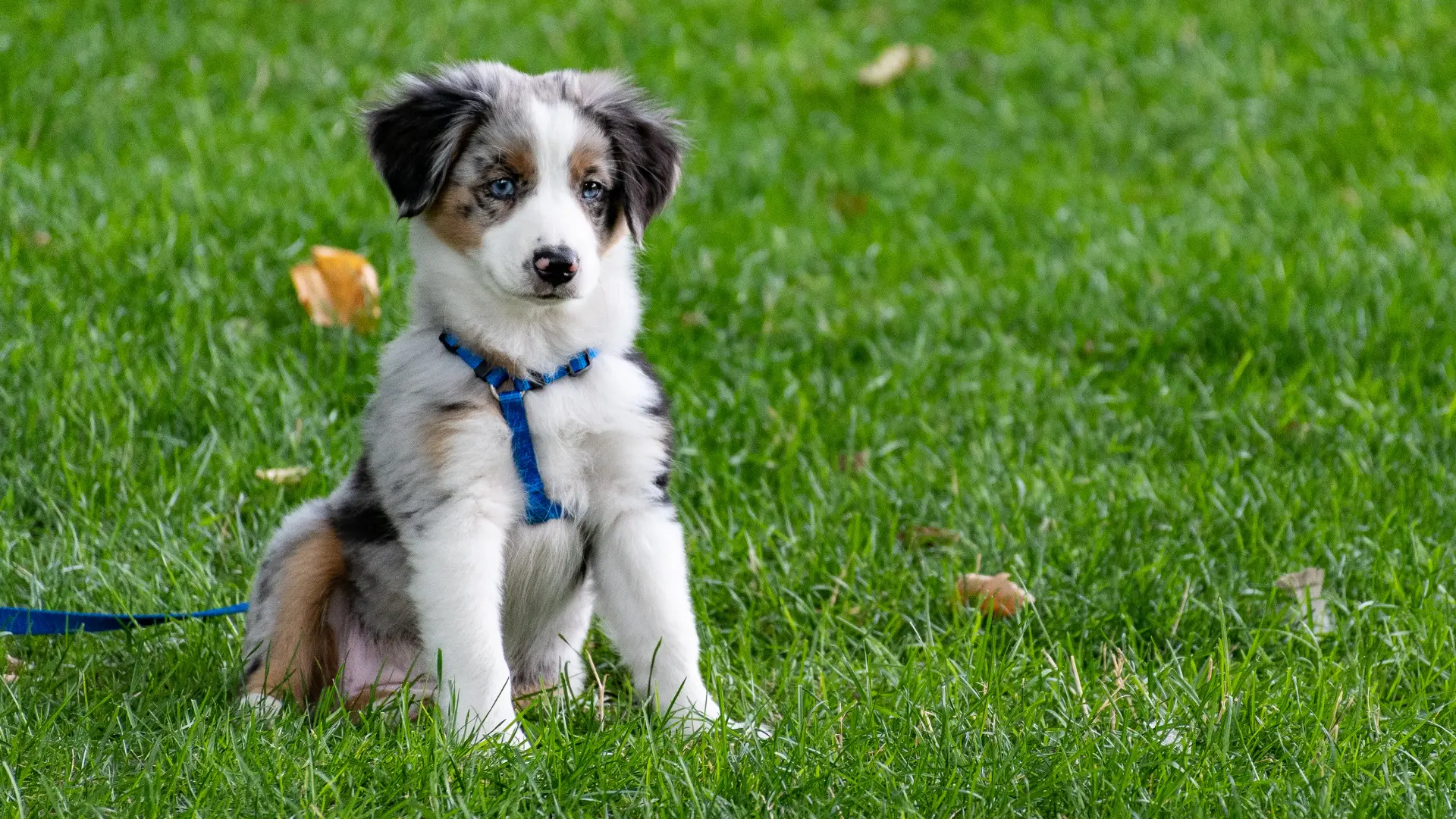
Puppies from 8 weeks
Puppy Training in GlasgowGet The First Six Months RightAnd Skip Years Of Problems
One structured plan that fixes toileting, biting, night-time crying, jumping up and lead walking while your puppy's brain is still at its most flexible. So you spend the next decade enjoying your dog instead of managing it. We come to your home, work with your actual routine, and leave you with written steps you can practise in ten minutes a day.
4.7★ from 185 Google reviews · 17+ years working with Glasgow dogs · we aim to reply to every enquiry within 48 hours.
4.7★ · 185 Google reviews
Verified on our Google Business Profile
17+ years' experience
Family homes, rescue shelters and courtrooms
Karen Pryor Academy trained
John holds the KPA Dog Trainer Professional qualification
48-hour response
We aim to reply to every enquiry
Fully insured
Public liability + care-of-custody cover
What this service is
Everything your puppy learns in the first six months becomes the default for life
Puppy training is not obedience for show. It is the deliberate teaching of the handful of skills that decide whether the next twelve years are easy or exhausting: settling alone without panic, toileting outdoors, letting go of hands and trousers, walking on a loose lead, coming back when called, and being handled by you, the groomer and the vet without a fight.
We work in your home and on your streets, because that is where the behaviour actually happens. A puppy that sits beautifully in a hall full of other puppies is not the same puppy that hears a bin lorry on Great Western Road. Sessions cover the exact triggers on your route, the layout of your flat or house, your family's schedule, and who does what when nobody is watching.
Everything is reward-based and positive reinforcement led. We never use prong collars, e-collars, slip leads or check chains. With a puppy, correction-based handling teaches avoidance of you rather than confidence in the world, and it is the single fastest way to create the fearful adolescent we later get called back to fix.
You also get the part most puppy classes skip: a realistic socialisation plan. Socialisation is not meeting as many dogs and people as possible. It is controlled, positive exposure at a distance your puppy can cope with, so that novelty predicts calm rather than chaos. Done properly between eight and sixteen weeks, it prevents most of the reactivity cases we see in adolescent dogs.
Who it's for
- First-time owners who want to avoid the mistakes rather than repair them
- Families with children where the puppy is nipping hands, sleeves and ankles
- Breeder puppies collected at 8 to 10 weeks with no groundwork done
- Rescue or import puppies with an unknown early history
- Owners who work and need a puppy that can be left calmly and gradually
- Anyone with a second dog in the house and a puppy learning bad habits from it
When to get help
- The week you bring your puppy home. Earlier is cheaper than later
- Toileting has stalled or gone backwards after a few good days
- Biting is drawing blood or frightening children
- Your puppy screams when left, even for two minutes
- Your puppy freezes, hides or barks at traffic, strangers or other dogs
- You are already being told to 'show them who's boss'
What happens if it's left
Puppy problems do not get outgrown. They get practised.
Every day a behaviour is rehearsed, it gets more automatic. A puppy that pulls for eight weeks has done a few thousand repetitions of pulling before you ever start training it out. A puppy that learns barking makes visitors back off has been paid for barking every single time. By six months the same behaviour is stronger, faster and attached to a much bigger, heavier dog.
The adolescent cases we are called into at nine to eighteen months are, overwhelmingly, puppy problems that were left. Lead reactivity that started as frustrated greeting. Separation panic that started as a puppy left too long, too soon. Resource guarding that started as a hand going into a food bowl 'to prove it was allowed'. None of those dogs were badly bred. They were badly informed.
There is a genuine window here. The socialisation period closes around sixteen weeks and a secondary fear period commonly lands somewhere in adolescence. Work done inside the window costs a fraction of the work needed outside it, both in sessions and in the amount of daily management you have to live with for the rest of the dog's life.
And the cost is not only training. It is the walk you stop taking, the visitors you stop having, the chewed skirting board, the neighbour complaint about howling, and in the worst cases the bite incident that turns a family pet into a legal problem. We have written behavioural reports for court cases that began with a puppy nobody helped in time.
The most common mistakes we're called in to undo
- Waiting until the puppy is 'old enough for training'. The learning has already started, just not with you.
- Free socialisation in busy parks: being bowled over by strange dogs teaches fear, not friendliness.
- Punishing growling or toilet accidents, which teaches the puppy to hide the warning and hide the mess.
- Using a slip lead or half-check on a pulling puppy instead of teaching the puppy where to walk.
- Rewarding jumping up with attention, then correcting it at random. Inconsistency is what confuses dogs.
- Leaving a puppy for a full working day from week one and hoping it settles on its own.
- Following contradictory advice from four YouTube channels, so the puppy gets four different rule sets.
How we work
A structured plan, not a one-off lesson you have to interpret yourself
Step 1
Enquiry and history
You send your puppy's age, sex, breed, how long you've had them and what's going wrong. We reply, usually within 48 hours, with honest options and whether you need one session or a block.
Step 2
In-home assessment
We watch your puppy in the environment where the behaviour happens: sleeping area, feeding routine, garden access, the front door, who's involved and what's already been tried.
Step 3
Written plan and priorities
You get a short, ordered plan. What to work on this week, what to actively manage, and what to ignore for now. Doing three things properly beats twelve things vaguely.
Step 4
Coached practice
We teach you the mechanics: timing, reward placement, lead handling, how to mark the moment. You practise with your own puppy while we correct your hands, not your dog.
Step 5
Progress and troubleshooting
Follow-up sessions, in person or by video, adjust the plan as your puppy hits adolescence. Regression at seven months is normal and we plan for it rather than react to it.
Step 6
Independent handling
The endpoint is you, unaided, able to read your dog and adjust. You keep the written plan and can add sessions later at any point without starting over.
What you get out of it
Specific outcomes you can measure in weeks, not vague promises
Toileting sorted in weeks
A schedule based on your puppy's real bladder capacity, feeding times and access to outdoors. With a plan for flats and stairs where the garden is not two steps away.
Biting that stops without pain
Redirection, arousal management and rest scheduling. Most puppy biting is overtiredness and over-excitement, not aggression, and it responds fast to the right handling.
A puppy that can be left
Graduated alone-time built from seconds upwards, so you never have to test whether your puppy can cope with four hours by leaving them for four hours.
Walks that start well
Loose-lead mechanics and harness fit from the first walk, so you never have to un-teach pulling on a dog that will eventually outweigh your grip.
Safety around children and visitors
Clear house rules, a settle station and consent-based handling so children learn to interact safely and the puppy learns visitors are boring, not thrilling.
Fewer bills later
Early work is the cheapest behavioural insurance there is. Aggression and separation cases take far more sessions than prevention ever does.
The detail
Methods, equipment and the variations of this work we handle
Equipment we use. And what we will never put on your puppy
Kit matters less than timing, but bad kit actively undermines training. We work with a well-fitted Y or H shaped harness, a fixed-length lead for street walking, a long line for recall in safe open spaces, high-value soft food rewards that can be delivered quickly, a licky mat or stuffed toy for settle work, and a crate or pen only where the puppy has been taught to like it.
The harnesses we recommend are Perfect Fit, Ruffwear and the Copenhagen Harness. We are not commercially affiliated with any of these products. The front yolk should be Y or H shaped and should not restrict the shoulders, and optimally the front clip is not used. Attaching a lead to the neck causes strain and often damage to the muscles and nerves as well as the throat, so unless there is a valid medical reason for not wearing a harness, our recommendation is that harnesses are used in all cases.
We do not use prong collars, electric or vibration collars, slip leads, half-checks or check chains at any point, on any dog, at any age. Retractable leads are also discouraged for puppies because they teach constant tension, the exact sensation we are trying to remove from lead walking.
- Y or H shaped harness fitted so the front yolk clears the shoulders
- Perfect Fit, Ruffwear or Copenhagen Harness, with no commercial affiliation on our part
- Fixed lead for streets, long line for open space
- Food rewards graded by value so you can pay more for harder work
- Settle mat used consistently in one or two places in the house
- Barriers and pens used for management while training catches up
Methods: what reward-based puppy training actually involves
We use marker-based training. A clear signal that tells the puppy the exact instant they got it right, followed by a reward. John holds the Karen Pryor Academy Dog Trainer Professional qualification, and that mechanical precision is what separates training that sticks from training that only works while food is visible.
Behaviours are shaped in small approximations, then generalised: same skill, new room, new surface, new distraction, new person asking. Puppies do not generalise on their own, which is why a puppy who sits in the kitchen appears deaf in the street. We build the ladder deliberately instead of assuming the dog will climb it.
Arousal and rest are treated as part of the curriculum. Most 'naughty' puppies in Glasgow homes are chronically over-stimulated and under-slept. Structured rest, chewing outlets and predictable routine remove a large slice of the problem before any obedience is taught.
Variations of puppy work we deliver
Not every puppy needs the same service, so the work is delivered in the format that fits the case.
- Pre-puppy consultation before collection day. Set the house up before the puppy arrives
- Single-session foundation visits for owners who mainly need the plan and the mechanics
- Blocks of 1-to-1 sessions for puppies with an existing problem such as biting or fear
- Remote video sessions for owners outside our travel area or between in-person visits
- Support for second-dog households where an adult dog is teaching the puppy bad habits
- Rescue and import puppy work where early history is unknown and fear is already present
- Self-paced online courses and our monthly membership for owners who want to keep learning independently
Glasgow-specific realities we plan around
Tenement flats, communal closes and shared back courts change the plan. A puppy that must cross a close and two flights of stairs before it reaches grass needs a different toileting schedule than one with a back door. Puppies raised in flats also meet neighbours in confined stairwells, which is a socialisation opportunity or a fear rehearsal depending on how it is handled.
We work across Glasgow, Greater Glasgow, East and West Dunbartonshire, North and South Lanarkshire, East Renfrewshire, Renfrewshire, Inverclyde, Falkirk and East Ayrshire. Sessions take place at your home or outdoors locally to you, we are a service-area business with no premises for clients to visit, so training happens in the world your puppy actually lives in.
Traffic on main roads, buses, bin lorries, cyclists on shared paths, dogs off-lead in busy parks and school-run crowds are all on the local socialisation list. We build exposure to those at your puppy's distance, in the order that keeps them under threshold.
Questions we're asked every week
Straight answers before you get in touch
How much does puppy training in Glasgow cost?
Sessions are booked individually or as a block, and we quote once we know what your puppy actually needs. A foundation visit is very different from a block for a fearful puppy. Send a short history through the form and we'll explain the options with prices before you commit to anything. Our self-paced online courses are separately priced between £30 and £150, and the monthly membership is £43 per month.
What age can my puppy start?
As soon as they're home, usually eight weeks. There is no waiting period. The socialisation window closes around sixteen weeks, so the earliest sessions are the highest-value ones. We also run pre-puppy consultations before collection day.
How long until I see a difference?
Most owners see meaningful change in toileting, biting and settling within two to three weeks of consistent daily practice, because those behaviours respond quickly to routine and timing. Lead walking and recall are skills that keep developing over months as distractions increase.
Do you use puppy classes or one-to-one sessions?
Our puppy work is one-to-one, in your home and local environment. Group classes suit some dogs, but they teach you to handle your puppy in a hall full of other puppies rather than on your own street, and fearful puppies often learn very little in that setting.
Do you guarantee results?
We don't sell guarantees, because your puppy's behaviour depends on what happens in the 167 hours a week we're not there. What we commit to is a written plan, honest expectations, coaching until you can execute it, and 17+ years of experience behind the decisions. Judge us on our 185 Google reviews at 4.7 stars.
Is my puppy too young to be left alone?
Alone-time is a trained skill, not an age. We build it from a few seconds upwards with the door, then the room, then the flat, so the puppy never rehearses panic. If you work full days, tell us that up front and we'll plan cover honestly rather than pretend it isn't an issue.
My puppy is biting the children. Is that aggression?
Almost always no. Puppy mouthing is normal exploratory and over-arousal behaviour, and it escalates when the puppy is tired or the game gets too exciting. We fix it with redirection, rest scheduling and clear rules for the children, not with punishment. Which is what turns mouthing into genuine defensive biting.
How quickly will you get back to me, and do you take urgent cases?
We aim to reply to all enquiries within 48 hours, occasionally slightly longer when volumes are high. If something is urgent, a bite, a puppy that can't be left at all, an imminent deadline. Call 07790 608841 rather than waiting on email.
Which areas around Glasgow do you cover for puppy visits?
Glasgow and Greater Glasgow, South and North Lanarkshire, East Renfrewshire, Renfrewshire, East and West Dunbartonshire, Inverclyde, Falkirk and East Ayrshire. Outside those areas, remote 1-to-1 video sessions cover the same material.
Are you insured?
Yes. We hold public liability insurance and professional care-of-custody cover for handling dogs.
Related training and next steps
Next step
Start your puppy with the right plan while it still costs you weeks, not years
Send us your puppy's age, breed, how long you've had them and what's going wrong at home. We'll come back with an honest assessment of what needs fixing first and what it will take. No aversive tools, no lectures, no blame.
07790 608841- Free, no-pressure discovery call to start, with no obligation to book
- 4.7★ from 185 Google reviews
- Public liability and care-of-custody insured
- Reward-based only, no prong collars, e-collars, slip leads or check chains