
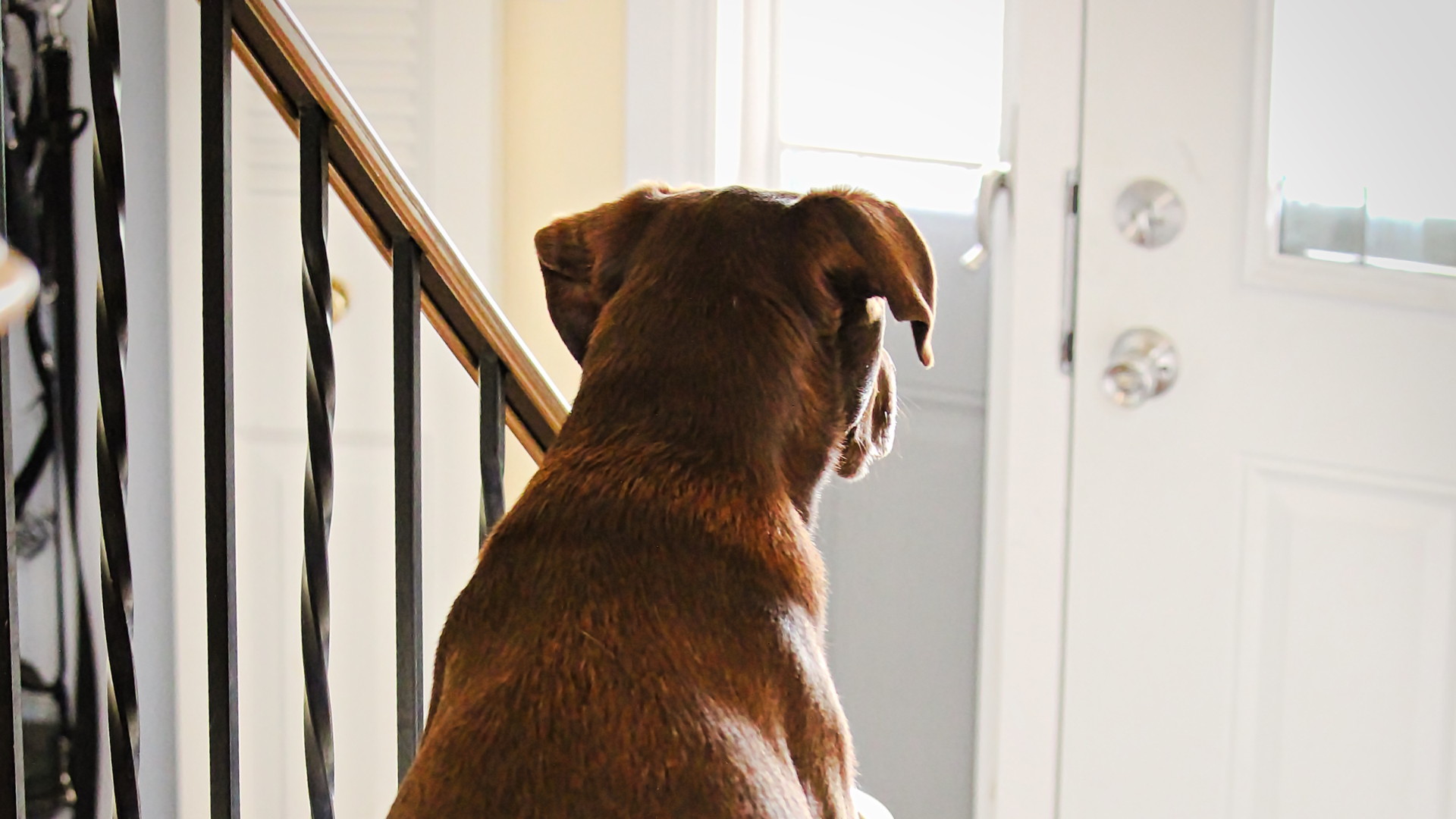
Dogs that cannot be left alone
Separation Anxiety TrainingFor Glasgow Dogs That PanicThe Moment You Leave
Howling that your neighbours can hear, destruction at the front door, toileting in a clean dog, or a dog that follows you room to room and shakes when you pick up your keys. We build alone-time back from seconds upwards on a staged plan, so your dog stops rehearsing panic and you stop planning your life around the door.
4.7★ from 185 Google reviews · 17+ years' experience · staged plans with no crating-and-hoping and no aversive tools.
4.7★ · 185 Google reviews
Verified on our Google Business Profile
17+ years' experience
Family homes, rescue shelters and courtrooms
Karen Pryor Academy trained
John holds the KPA Dog Trainer Professional qualification
48-hour response
We aim to reply to every enquiry
Fully insured
Public liability + care-of-custody cover
What this service is
Separation anxiety is a panic disorder, not disobedience or spite
A dog with separation-related distress is not making a point about being left. It is experiencing genuine panic, elevated heart rate, drooling, pacing, vocalising, sometimes self-injury at exit points. That is why punishment, tiring the dog out and 'letting them cry it out' either fail or make things measurably worse: you cannot discipline a panic attack out of an animal.
The work is a graduated exposure plan. We establish the exact point at which your dog begins to struggle, often much earlier than owners expect, sometimes at the shoe-and-keys stage rather than the door. Then build duration in tiny, non-scary increments, using your dog's own body language as the criterion for progressing. Nothing in the plan involves letting your dog panic to see what happens.
We also address the surrounding conditions that keep the problem alive: departure cues that predict abandonment, an unpredictable daily routine, unmet needs before departures, an inability to settle even when you are home, and in flats, the noise of the close that arrives at exactly the wrong moment.
All of it is reward-based. We never use prong collars, e-collars, slip leads, check chains, bark collars or anti-bark devices. Suppressing vocalisation in an anxious dog silences the symptom while the distress continues, and that is a welfare problem as well as a training failure.
Who it's for
- Owners who have had a noise complaint or a letter from a landlord or factor
- Dogs that destroy doors, frames, blinds or windowsills when left
- Lockdown and rescue dogs that have never been alone
- House-trained dogs that soil only when left
- Velcro dogs that cannot settle unless they are touching you
- Owners returning to office work after a period at home
When to get help
- Your dog vocalises within minutes of you leaving, every time
- You have not left the house alone in weeks or months
- There is drooling, panting, trembling or refusal of food before you go
- Damage is concentrated at doors, windows or your exit route
- Your dog has injured itself trying to escape a crate or room
- A new job, holiday or hospital stay is coming and you have no plan
What happens if it's left
Every panicked departure teaches your dog that being left is genuinely dangerous
Separation distress is one of the few behaviour problems where doing nothing actively trains the opposite of what you want. Each time a dog is left beyond its tolerance and panics, the association strengthens. The dog does not learn 'they always come back'; it learns 'that was terrifying and it lasted an hour'. Weeks of that produce anticipatory panic, the shaking starts when you touch your keys.
The physical risks are real. Dogs break teeth and claws on doors and crate bars, injure their mouths chewing frames, escape through windows, and in severe cases ingest fabric or wood that requires surgery. Chronic stress also affects appetite, sleep, gut function and skin, and it makes every other behaviour problem you're dealing with harder to train.
The consequences for you are more immediate than most owners admit before they ask for help: noise complaints, neighbour hostility, tenancy warnings, damage bills, cancelled plans, missed work, no holidays, and a slow narrowing of life until someone is always home. Separation anxiety is one of the most common reasons dogs are returned to rescue in Scotland, usually by people who love the dog and simply ran out of options.
It is also one of the problems where the wrong advice does most damage. 'Get a crate and let him scream' turns a room-scale panic into a confinement-scale panic. 'Tire him out first' produces a dog too exhausted to cope. An anti-bark collar removes the sound your neighbours hear and leaves the dog silently frantic. All three make the eventual repair job longer.
The most common mistakes we're called in to undo
- Crating a panicking dog for confinement. Most separation cases get dramatically worse in a crate.
- Testing progress by leaving for an hour to 'see how he does', which undoes weeks of staged work.
- Buying an anti-bark or citronella collar, which punishes distress without touching the cause.
- Assuming exercise is the fix. Physical tiredness does not create emotional safety.
- Making departures dramatic with long goodbyes, or hiding departures entirely so they become unpredictable.
- Getting a second dog to keep the first company. Separation from the person is usually the issue.
- Skipping the vet check when there's sudden onset, incontinence or gastrointestinal signs alongside the distress.
How we work
A structured plan, not a one-off lesson you have to interpret yourself
Step 1
Written history and baseline
We take a detailed history. Age, breed, time owned, onset, current departure routine. And ask you to record your dog alone on a phone or camera so we can see what actually happens.
Step 2
Video assessment and threshold finding
We identify the precise moment distress begins and what predicts it. Many dogs are already struggling before the door closes, which changes where the plan starts.
Step 3
Stop the rehearsal
We put a suspension plan in place. Cover, daycare, a sitter, changed shifts, whatever is workable. So your dog is not panicking daily while training runs.
Step 4
Staged absence plan
A written protocol that builds duration in small increments, with clear rules for when to increase, when to hold and when to step back. Body language decides pace, not the clock.
Step 5
Independence and settle work
In parallel we build the ability to relax when you are home. A settle station, room separation, predictable routine and enrichment that requires no company.
Step 6
Verification and maintenance
Progress is verified on camera at each duration before moving on, and we hand you a maintenance plan so real life. Holidays, shift changes, illness. Does not restart the problem.
What you get out of it
Specific outcomes you can measure in weeks, not vague promises
Your dog stops rehearsing panic
Suspending unmanaged absences is often the single fastest improvement, and it usually happens in week one.
Objective progress you can see
Camera footage at every stage means you know whether four minutes is genuinely comfortable, rather than hoping.
Neighbour problems calm down
Reducing vocalisation properly protects your tenancy, your relationships in the close and your dog's future in the home.
No more damage bills
Fewer chewed doors, frames and windowsills, and less risk of the injuries and surgeries that come with escape attempts.
Your life opens up again
A staged plan gets you back to shops, work and evenings out with a realistic timeline instead of an indefinite wait.
A dog that can relax generally
Settle and independence work lowers baseline arousal, which improves sleep, recovery and everything else you're training.
The detail
Methods, equipment and the variations of this work we handle
Separation anxiety, boredom and confinement distress are not the same problem
Accurate assessment matters because the plans diverge. True separation-related distress involves panic tied to being left, usually starting within minutes and often before departure. Boredom-driven destruction tends to start later, targets interesting objects rather than exit points, and improves with enrichment. Confinement distress is about the crate or room rather than your absence, and it appears even when you are home.
Some dogs have more than one of these. Some have none of them and are actually reacting to noise in the close, post arriving, or another dog barking outside. Video assessment is how we tell the difference, and it prevents months of work aimed at the wrong target.
- Exit-point damage, vocalisation within minutes, drooling or pacing: separation-related distress
- Damage to novel or interesting items later in the absence: often under-stimulation
- Distress present in the crate while you are home: confinement distress
- Barking at specific external events: noise sensitivity rather than separation
- Toileting in an otherwise clean dog only when left: distress-related, not house-training
Methods: graduated exposure done properly
The plan is systematic desensitisation to absence. We start below threshold, for some dogs that means picking up keys and sitting down again, and increase duration in increments the dog does not notice, watching for the earliest signs of unease rather than waiting for vocalisation. Progress criteria are written down so you are not making judgement calls in the moment.
We deliberately break the predictive chain of departure cues, so shoes, coat, keys, alarm and door handle stop functioning as warnings. We use enrichment strategically rather than as a distraction that masks distress, and we build a settle behaviour that has value in its own right.
John holds the Karen Pryor Academy Dog Trainer Professional qualification and the plan is built on the same reinforcement principles as our other work. What separates a successful separation case from a failed one, though, is usually discipline about not exceeding threshold. Which is why we track it on camera instead of guessing.
Practical variations and Glasgow living
In tenement flats, the close is part of the plan. Footsteps on shared stairs, the buzzer, neighbours' doors and the letterbox all arrive during absences, and a noise-sensitive dog needs those addressed alongside duration work. Sound masking, room choice and window management all get considered.
Where owners work full days, we are honest: the plan needs cover while it runs. That might be a walker, daycare, a family member, a sitter or adjusted shifts. Working through a full day of panic every day while doing five-minute training exercises in the evening does not work, and we will not pretend it does.
We also handle cases alongside veterinary care. Where distress is severe, your vet may consider medication to bring the dog into a state where it can learn. That decision is theirs, and we work alongside it. We accept veterinary referrals and take clients directly, so you can get in touch yourself.
- Home visits across Glasgow and the surrounding areas, plus remote 1-to-1 video sessions
- Written protocols you can follow between sessions without needing us present
- Camera-verified progress at each duration step
- Plans for shift workers, home workers returning to offices and multi-dog homes
- Support for rescue dogs with unknown history and dogs with no alone-time experience at all
How long the work usually takes
Separation cases are measured in weeks and months, not sessions. Mild cases with good management and consistent daily practice often reach a workable absence within four to eight weeks. Severe cases, dogs that cannot cope with the handler leaving the room, dogs with an injury history at exit points. Take longer, sometimes several months, and progress is not linear.
That is a deliberate feature of the method. We could produce silence faster with suppression, and it would leave you with a distressed dog who no longer tells you. Building genuine tolerance takes longer and holds when life gets disrupted.
Questions we're asked every week
Straight answers before you get in touch
How much does separation anxiety training cost in Glasgow?
Sessions are booked individually or as a block and we quote once we've read your history and, ideally, seen video of your dog alone. Separation cases usually need several touchpoints over weeks rather than a single visit, and we'll set out realistic options and prices before you commit. Our monthly membership at £43 per month is an option for ongoing support alongside sessions.
How long will it take before I can leave my dog?
Mild cases often reach a workable absence in four to eight weeks with consistent daily practice. Severe cases can take several months. Anyone promising a fix in a week is either suppressing the symptoms or has assessed a different problem.
Should I use a crate?
Usually not for a dog with separation distress. Confinement commonly intensifies panic and adds injury risk at bars and doors. If your dog genuinely loves its crate and settles there while you are home, we may use it. That decision comes after assessment, not before.
Will an anti-bark collar stop the howling?
It may stop the sound. It will not stop the panic, and we do not use or recommend them, along with prong collars, e-collars, slip leads and check chains. Silencing a distressed dog removes your only signal that something is wrong.
I work full time. Can this still be fixed?
Yes, but the plan needs cover while it runs. A walker, daycare, a sitter or adjusted hours. Training progress and daily unmanaged panic cancel each other out. Tell us your real schedule and we'll build around it honestly.
Would getting a second dog help?
Rarely. Most separation cases are about separation from a specific person, and a second dog then means two dogs rehearsing distress. We would want to see video evidence that isolation rather than person-absence is the driver before anyone considers it.
Do I need a vet referral, and could this be medical?
No referral needed. We accept veterinary referrals and take clients directly. Sudden onset in an older dog, incontinence, or distress alongside gastrointestinal or pain signs should be checked by your vet first. In severe cases your vet may consider medication to make learning possible, and we work alongside that.
Is separation anxiety permanent?
Many dogs reach genuinely comfortable absences and stay there with sensible maintenance. Some remain dogs who need a routine and a plan for life. We will tell you which looks likely for your dog rather than selling you the better-sounding answer.
How fast do you reply, and can you help urgently?
We aim to reply within 48 hours, sometimes slightly longer when enquiry volumes are high. If you have a tenancy warning, an imminent return to work or a dog injuring itself, call 07790 608841 rather than emailing.
Do you cover my area, and can you work remotely?
We cover Glasgow, Greater Glasgow, South and North Lanarkshire, East Renfrewshire, Renfrewshire, East and West Dunbartonshire, Inverclyde, Falkirk and East Ayrshire in person. Separation work is also one of the best cases for remote 1-to-1 video sessions, because the assessment is video-based anyway.
Are you insured?
Yes. Public liability insurance and professional care-of-custody cover for handling dogs.
Related training and next steps
Next step
Build alone-time back properly, starting with the next hour rather than the next crisis
Send your dog's age, sex, breed, how long you've owned them, when the distress started and what happens when you leave. If you can film five minutes of your dog alone, say so. It makes the first assessment far more accurate.
07790 608841- Free, no-pressure discovery call to start, with no obligation to book
- 4.7★ from 185 Google reviews
- Public liability and care-of-custody insured
- Reward-based only, no prong collars, e-collars, slip leads or check chains