Live video sessions, anywhere
Remote 1-to-1 Dog TrainingLive Video Sessions From GlasgowAnywhere In The UK Or Abroad
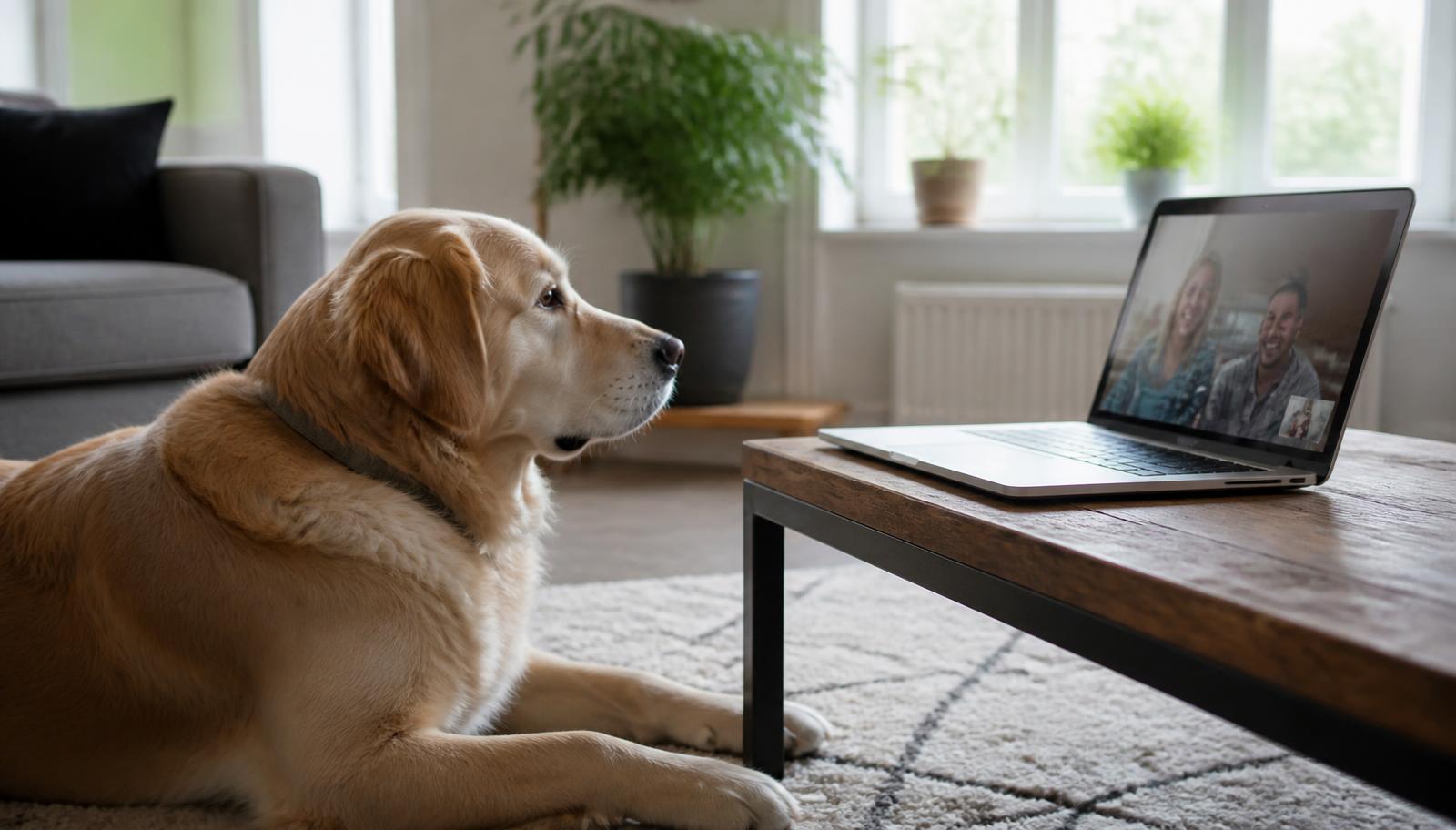
The same assessment, written plan and coached handling as an in-person session, delivered by live video. So you get 17+ years of behaviour experience without needing to live within driving distance, and without a stranger walking into a home your dog already finds stressful.
4.7★ from 185 Google reviews · 17+ years' experience · clients across the UK and internationally, including a returning client from Austria.
4.7★ · 185 Google reviews
Verified on our Google Business Profile
17+ years' experience
Family homes, rescue shelters and courtrooms
Karen Pryor Academy trained
John holds the KPA Dog Trainer Professional qualification
48-hour response
We aim to reply to every enquiry
Fully insured
Public liability + care-of-custody cover
What this service is
Remote sessions work because most dog training is actually handler coaching
Almost every training problem is solved by changing what the human does: timing, reward placement, distance, criteria, management. Those are exactly the things that can be coached over video, and often coached better, because we are watching you handle your own dog in your own environment rather than in a session your dog has been primed for by a stranger's arrival.
A remote session follows the same structure as an in-person one. You complete a detailed written history first. We assess, either live or from video you record beforehand. We agree the plan, coach you through the first exercises with your dog in real time, and you receive a written protocol afterwards. Follow-ups track progress and adjust.
It suits puppies, adolescents, loose-lead and recall work, everyday manners, separation-related distress, noise phobias, fearful dogs, resource guarding and reactivity where the behaviour can be filmed or described accurately. It is also the natural fit for owners outside our travel area, expats with UK-purchased dogs, and anyone who has already had a trainer out and needs a second opinion.
It is the same methodology throughout: reward-based, positive reinforcement led, no fear and no pain. We do not recommend prong collars, e-collars, slip leads or check chains in remote sessions any more than we would use them in person.
Who it's for
- Owners outside Glasgow and the west of Scotland
- People who want a second opinion after conflicting advice
- Anxious or shut-down dogs that do worse with a visitor in the house
- Separation-related cases, where assessment is video-based anyway
- Busy households that can find an hour but not a half-day
- International clients, including UK expats and owners abroad
When to get help
- You are outside our in-person service area
- You need help sooner than travel schedules allow
- Your dog cannot cope with a stranger entering the home yet
- You want ongoing coaching between milestones rather than one visit
- You have footage of the behaviour and need it interpreted properly
- You are a professional or rescue volunteer wanting case support
What happens if it's left
Waiting for the right postcode is how small problems become behaviour cases
Behaviour problems are time-sensitive. Every week that a dog rehearses lunging, panicking when left, guarding the sofa or ignoring recall makes the behaviour more established and the eventual plan longer. Owners who wait months for a local specialist, or who never find one, are effectively letting the problem train itself in the meantime.
The alternative most people take is worse: piecing a plan together from social media, YouTube and conflicting advice from well-meaning people at the park. That is how dogs end up flooded to 'socialise' them, punished for growling, or fitted with a slip lead that makes the pulling and the reactivity worse. Undoing bad advice is a substantial part of our workload.
There is also the cost of the wrong professional. Dog training is unregulated in the UK, which means anyone can print a card, and the cheapest available option locally is not always safe. Owners who feel they have no choice geographically often accept methods they are uncomfortable with, then arrive to us later with a suppressed dog and a bite history.
Remote sessions remove the geography problem entirely. You get assessed properly this month rather than hoping something local turns up, and if the case genuinely needs hands-on work, we will tell you that rather than taking the booking.
The most common mistakes we're called in to undo
- Assuming remote training is a watered-down version. The plan, protocol and follow-up are the same.
- Booking a session with no history submitted, which wastes the first half of the call on basics.
- Filming ten seconds of the worst moment instead of the full sequence, including what happened before it.
- Working from free video content without an assessment, and applying the right technique to the wrong problem.
- Accepting aversive methods because they were the only local option.
- Trying to hold the session on a phone in one hand while handling the dog with the other. A propped camera changes everything.
- Delaying because you assume a behaviour case must be seen in person.
How we work
A structured plan, not a one-off lesson you have to interpret yourself
Step 1
Detailed written history
Before the session you send your dog's age, sex, breed, time owned, the full behaviour history and what you have already tried.
Step 2
Video evidence
Where relevant we ask for short clips. The walk, the departure, the trigger, the greeting. Filmed as they actually happen rather than staged.
Step 3
Live assessment
We review the history and footage with you, ask the questions that narrow the diagnosis, and identify what is actually maintaining the behaviour.
Step 4
Coached practice on the call
With your camera propped, we coach the first exercises live: your timing, positioning, reward placement and criteria, adjusted in real time.
Step 5
Written protocol
You receive a written plan with the exercises, progression criteria and management changes, so nothing depends on remembering the call.
Step 6
Follow-up and verification
Follow-up sessions review new footage, confirm the criteria are being met and progress the plan. Or refer you on if hands-on work becomes necessary.
What you get out of it
Specific outcomes you can measure in weeks, not vague promises
No geographic limit
Behaviour expertise available wherever you are in the UK or abroad, with no travel time added to the cost.
Your dog stays in its normal state
No visitor arriving, so we see the real baseline. Particularly valuable with fearful, territorial or shut-down dogs.
You are the one handling the dog
Because we coach rather than demonstrate, the skill lives with you from the first session instead of transferring later.
Faster to start
Sessions can usually be scheduled sooner than home visits, which matters when a behaviour is escalating weekly.
Evidence-based review
Footage lets us compare week three with week one objectively rather than relying on impressions.
Flexible scheduling
Evening and weekend availability within our opening hours, which suits shift workers and busy households.
The detail
Methods, equipment and the variations of this work we handle
What remote sessions handle well. And what they do not
We are direct about the limits, because sending you the wrong service wastes your money. Remote work is excellent where the plan is built on handler mechanics, management and staged exposure. It is weaker where hands-on assessment or a controlled set-up with a helper dog is genuinely required.
- Well suited: puppy foundations, adolescent recall and lead work, everyday manners and settling
- Well suited: separation-related distress, where camera assessment is the correct method anyway
- Well suited: noise phobias, fireworks preparation and confidence building
- Well suited: resource guarding protocols, swap training and household management
- Well suited: second opinions, and support for professionals and rescue volunteers
- Often needs in-person work: controlled set-ups with a neutral helper dog for reactivity progression
- Needs in-person work: formal behavioural assessment for expert witness and dog bite cases
Getting a good session: setup, filming and preparation
The practical details make a large difference. Prop your phone or laptop rather than holding it, so both hands are free for lead and rewards. Choose a space where the camera can see you and the dog together, we need to see your timing and the dog's body language in the same frame. Have rewards prepared and cut small, the harness and lead ready, and any other household members present if they will be involved in the plan.
For filming, capture the whole sequence rather than the peak. If your dog reacts to dogs on walks, we want the fifteen seconds before the bark, not just the bark. If your dog struggles when left, film from the moment you pick up your keys through the first ten minutes of absence. Context is where the diagnosis lives.
The same methods, and the same standards, as our in-person work
John holds the Karen Pryor Academy Dog Trainer Professional qualification, and every remote plan uses the same marker-based reinforcement approach as our home visits: clear criteria, high reinforcement rates while learning, staged generalisation, and management to prevent rehearsal. Dog training is an unregulated industry in the UK and qualifications like this are issued by private training providers rather than regulatory bodies, so we ask you to judge us on 17+ years of experience, 185 Google reviews and courtroom-tested behavioural work.
We never use or recommend prong collars, e-collars, slip leads or check chains. If you have been advised to use one, we will explain what it is likely to do to the behaviour you are trying to change and what we would do instead.
We also work alongside veterinary care. Where the history suggests pain or a medical contributor, we will ask you to involve your own vet, and where medication is being considered that decision sits with your vet or a veterinary behaviourist. We accept veterinary referrals and take clients directly, so you can get in touch yourself.
How remote work fits with our other services
Many clients use a combination. A remote consultation to assess and start the plan, then in-person sessions if you are inside our service area and controlled set-ups become necessary. Others pair remote coaching with our self-paced online courses, which run from £30 to £150, or with the monthly membership at £43 per month, which includes live group support.
For in-person work we cover Glasgow, Greater Glasgow, South and North Lanarkshire, East Renfrewshire, Renfrewshire, East and West Dunbartonshire, Inverclyde, Falkirk and East Ayrshire. We also deliver seminars and workshops for owners, rescue organisations and professionals, in person and online.
- Remote consultation plus in-person follow-up where you are inside the travel area
- Remote coaching alongside a structured online course for daily practice
- Membership for ongoing support between 1-to-1 sessions
- Case support and mentoring for rescue teams and professionals
Questions we're asked every week
Straight answers before you get in touch
How much does a remote 1-to-1 session cost?
Sessions can be booked individually or as a block and we quote based on the case. A puppy foundations session and a multi-session separation anxiety plan are different pieces of work. Send your dog's details through the enquiry form and we'll explain the options and prices before you commit.
How long is a session and what platform do you use?
Sessions are scheduled within our opening hours. Monday to Thursday until 8:30pm, Friday until 6pm and weekend availability. Using a standard video call link we send you. All you need is a stable connection and a device you can prop up.
Is remote training as effective as a home visit?
For handler-mechanics and management-led work, yes, and sometimes better because your dog behaves normally. For reactivity progression needing a controlled helper dog, or formal behavioural assessment for legal cases, in-person work is required and we will say so.
Can you help with aggression remotely?
We can assess, put safety management in place, teach disengagement skills and coach your handling. Where the case needs controlled set-ups, or where there is a bite history with legal implications, we will tell you what needs to happen in person.
Do you work with clients outside the UK?
Yes. We work with clients nationally and worldwide, including UK expats and owners abroad, and we've had international clients travel to work with us in person too.
What do I need to prepare?
Your completed written history, any video clips we've asked for, a propped camera, prepared rewards, your harness and lead, and anyone else in the household who will be following the plan.
What if my internet drops or my dog will not settle?
Neither is a problem. We work around interruptions, and a dog that will not settle on camera is useful information rather than a failed session. That is often exactly the behaviour we're there to address.
Do you use aversive tools or recommend them remotely?
Never. No prong collars, e-collars, slip leads or check chains. Every plan is reward-based and positive reinforcement led, no fear, no pain.
How quickly can I get an appointment?
We aim to reply to every enquiry within 48 hours, occasionally slightly longer when volumes are high. Remote slots are usually available sooner than home visits. If your situation is urgent, call 07790 608841.
Will I get anything in writing?
Yes. A written protocol with the exercises, progression criteria and management changes, so the plan does not depend on what you remember from the call.
Are you insured?
Yes. Public liability insurance and professional care-of-custody cover for handling dogs.
Related training and next steps
Next step
Get expert eyes on your dog this month, wherever you live
Send your dog's age, sex, breed, how long you've owned them, a detailed history of the behaviour and what you've already tried. Mention that you'd like a remote session and we'll come back with availability and options.
07790 608841- Free, no-pressure discovery call to start, with no obligation to book
- 4.7★ from 185 Google reviews
- Public liability and care-of-custody insured
- Reward-based only, no prong collars, e-collars, slip leads or check chains