
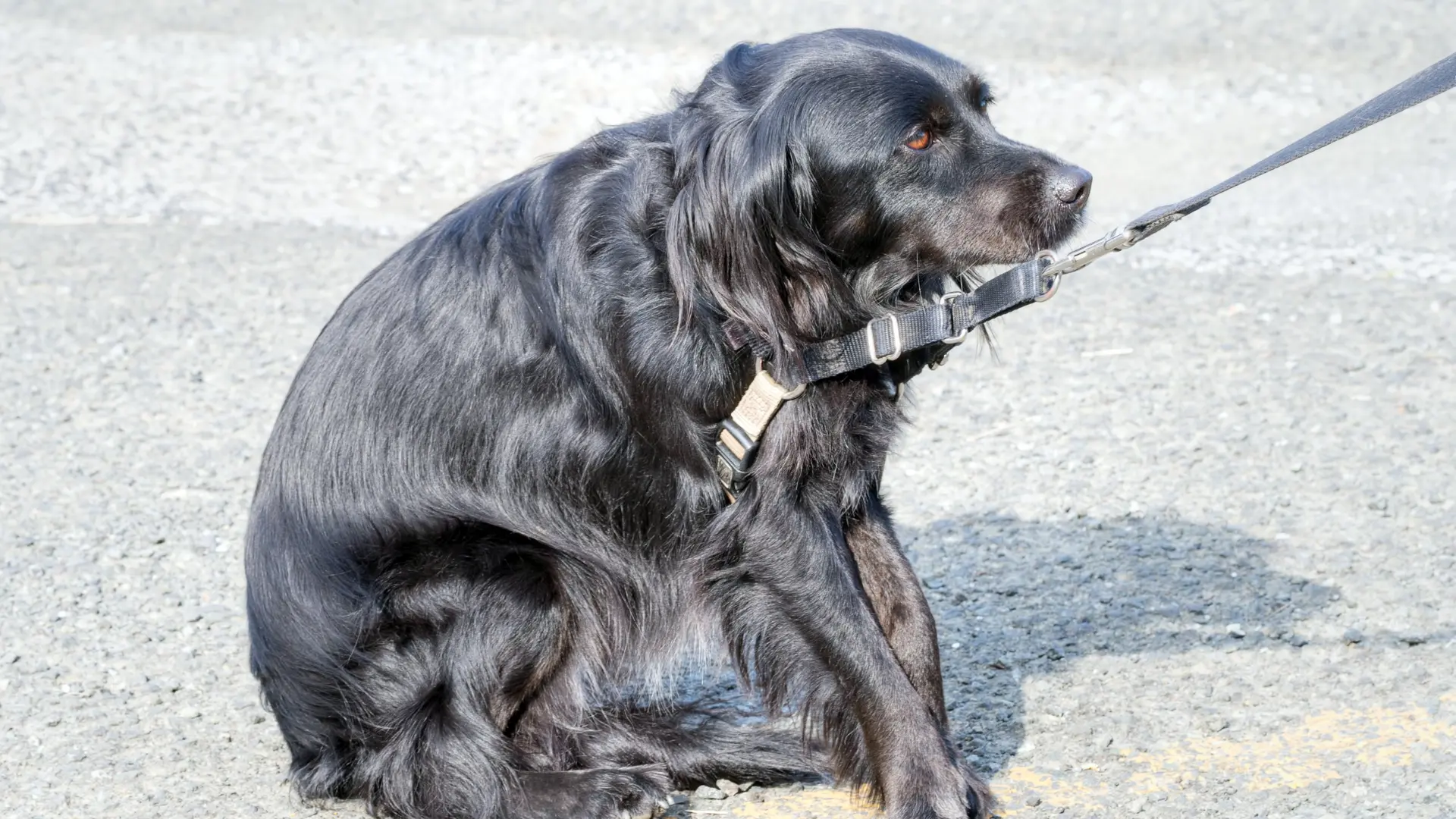
Fear, phobias and anxiety
Fearful & Anxious Dog TrainingIn Glasgow, At Your Dog's PaceNever By Flooding Them
Noise phobias, fireworks, traffic, strangers, hands, vets, other dogs, or a rescue dog that shuts down in the house. We build confidence in stages your dog can actually cope with, so the fear reduces instead of being hidden. And you stop bracing for November every year.
4.7★ from 185 Google reviews · 17+ years' experience · reward-based only, and we respond to enquiries within 48 hours.
4.7★ · 185 Google reviews
Verified on our Google Business Profile
17+ years' experience
Family homes, rescue shelters and courtrooms
Karen Pryor Academy trained
John holds the KPA Dog Trainer Professional qualification
48-hour response
We aim to reply to every enquiry
Fully insured
Public liability + care-of-custody cover
What this service is
Fear is a state, not a habit. So it has to be changed rather than corrected
A frightened dog is not choosing to be difficult. Fear is an involuntary physiological state: heart rate rises, the dog scans, the body tightens, and learning capacity drops sharply. That is why 'just get him used to it' fails so reliably, a dog held in a frightening situation is not habituating, it is rehearsing panic and learning that you will not get it out of there.
We work with fear of noises (fireworks, thunder, gunshots, bin lorries, DIY), fear of people (strangers, men, children, visitors, hi-vis), fear of places and surfaces, traffic and vehicle phobia, handling and grooming fear, vet fear, and generalised anxiety in dogs that never fully switch off. Rescue dogs with unknown history are a large part of this work, as are lockdown-era dogs who missed early exposure.
The plan changes the association rather than the behaviour. Trigger appears at a level the dog can tolerate, something genuinely good happens, and repeated over time the dog's prediction changes. Alongside that we build agency, the dog gets to move away, choose, and end interactions. Because a dog that knows it can leave is far less likely to escalate to defensive aggression.
We never use prong collars, e-collars, slip leads or check chains, and we do not use any technique that relies on the dog being unable to escape. Adding pain or restraint to fear produces suppression, learned helplessness and, in many cases, the fear-aggression cases we later assess.
Who it's for
- Rescue dogs settling into a home with unknown history
- Dogs that hide, tremble, pace or refuse food during fireworks or thunder
- Dogs that bark and retreat from strangers or visitors
- Dogs frightened of traffic, buses, bikes, prams or the vet
- Dogs that will not be handled, brushed, harnessed or examined
- Anxious dogs that never settle, startle at everything and struggle to sleep
When to get help
- Fear is spreading to new triggers or new locations
- Your dog has started growling or snapping when frightened
- Walks have shrunk, or stopped, because of what might happen
- Bonfire night and Hogmanay are on the calendar and last year was awful
- A vet visit, groomer or house move is coming up
- You have been told to 'show him there's nothing to be scared of'
What happens if it's left
Untreated fear does not fade with exposure. It generalises and it hardens
Fear that is regularly triggered spreads. A dog frightened of fireworks often becomes frightened of any bang, then of the room where the bang happened, then of going out after dark in autumn. This is ordinary associative learning working against you, and each frightening episode makes the next one easier to trigger and harder to recover from.
The second progression is more serious: avoidance turning into defence. When a dog cannot escape what frightens it, because it is on a lead, in a corner, or being held for grooming. The remaining option is to make the thing go away. Growling, snapping and biting are frequently the end-point of untreated fear, and once a bite has happened you may be dealing with insurance, a complaint, a dog control notice or legal proceedings rather than a training plan.
There is a welfare cost that is easy to miss because it is quiet. Chronically stressed dogs sleep badly, eat inconsistently, have more gut and skin problems, and are harder to train in every other area because their baseline arousal never comes down. Owners describe it as 'he's just never relaxed', and it is a real physiological state, not a personality.
For you, the cost is a shrinking life: no visitors, walks at unsociable hours, avoiding whole streets, dreading November, cancelling plans, and the low-grade dread of not knowing what will set the next episode off. That vigilance changes your handling, which your dog reads instantly, which feeds the loop.
The most common mistakes we're called in to undo
- Flooding. Taking the dog into the frightening situation to prove it is fine. It teaches the dog that it cannot get away.
- Telling owners not to comfort a frightened dog. You cannot reinforce an emotion, and support does not create fear.
- Using a slip lead, prong or e-collar on a fearful dog, which adds pain to a situation the dog already dreads.
- Pushing a rescue dog into meeting everyone in the first fortnight instead of letting it decompress.
- Forcing handling, brushing or nail trims until the dog gives up struggling, then calling that progress.
- Working at a distance the dog cannot cope with, so every session is a bad session.
- Ignoring pain. Sudden fearfulness, touch sensitivity or noise sensitivity in an adult dog warrants a vet check.
How we work
A structured plan, not a one-off lesson you have to interpret yourself
Step 1
Full written history
Age, breed, time owned, background, the full list of triggers, what your dog does, how long recovery takes, and anything already tried. Before we meet.
Step 2
Assessment and threshold mapping
We watch your dog in its real environment, read the early body language most owners miss, and map the distance, volume or intensity at which learning is still possible.
Step 3
Reduce pressure immediately
Management first: routes, timings, sound masking, safe spaces, visitor rules and a decompression plan so your dog stops being frightened daily.
Step 4
Written behaviour plan
Staged desensitisation and counter-conditioning with clear progression criteria, plus confidence and choice work that builds resilience rather than tolerance.
Step 5
Coached practice
We coach your timing, reward delivery and positioning in real situations, and set up controlled reps so your dog banks successes instead of scares.
Step 6
Verify and future-proof
We check progress against recovery time and threshold distance, then hand over a maintenance plan for fireworks season, vet visits and new environments.
What you get out of it
Specific outcomes you can measure in weeks, not vague promises
Fewer frightening episodes from week one
Management changes cut the number of daily scares before the behaviour plan has even started working.
A dog that recovers faster
Recovery time is the most useful early measure of progress. Dogs settle in minutes rather than hours.
Lower bite risk
Giving a frightened dog distance and choice removes the situations where defensive aggression is the only option left.
You can read your dog
You learn the early signals. The look away, the lip lick, the freeze. So you act before the panic, not after it.
Fireworks season becomes plannable
A prepared sound and safe-space plan, started well before November, rather than an emergency every autumn.
Better sleep and lower baseline stress
Reducing chronic arousal improves rest, appetite and recovery, and makes all other training work faster.
The detail
Methods, equipment and the variations of this work we handle
The types of fear we treat and why the plans differ
Fear looks similar from the outside. Avoidance, trembling, barking, freezing. But the treatment depends on what the trigger is and how controllable it is. Sound phobias can often be worked on with recordings, which gives you precise control over intensity. Social fear needs cooperative humans and strict rules about approach. Handling fear needs cooperative-care training with a clear consent signal.
- Noise phobia and sound sensitivity: fireworks, thunder, bangs, DIY, traffic noise, bin lorries
- Fear of people: strangers, men, children, high-vis, hats, visitors in the home
- Environmental and surface fear: shiny floors, stairs, lifts, vet waiting rooms, new places
- Traffic and movement fear: buses, lorries, bikes, scooters, prams, joggers
- Handling, grooming and veterinary fear, including nails, ears, harnesses and examinations
- Generalised anxiety and hypervigilance, common in rescue and under-socialised dogs
- Fear that has already tipped into growling or snapping, which we handle alongside our aggression work
Methods: desensitisation, counter-conditioning, cooperative care and choice
Systematic desensitisation means presenting the trigger below the level that frightens your dog, then increasing intensity in small, deliberate steps. Counter-conditioning pairs each presentation with something the dog genuinely values, so the emotional prediction changes. Done properly this is slow, unspectacular and durable. Done impatiently it is just repeated frightening.
For handling and veterinary fear we use cooperative care: the dog is taught a start-button behaviour. A chin rest, a paw offered, standing still. And every procedure stops when the dog withdraws it. That single change in control transforms grooming and vet work, and it removes the need for restraint that so often creates handling aggression.
We also build confidence directly, through pattern games, predictable routines, scentwork and low-pressure problem solving. Confidence work does not replace the exposure plan, but it raises the dog's ability to cope generally, which makes each step in the plan easier.
John holds the Karen Pryor Academy Dog Trainer Professional qualification, and marker timing matters enormously here: reinforcing the exact moment a fearful dog voluntarily looks at, steps towards or disengages from a trigger is how bravery gets built. Dog training is unregulated in the UK and qualifications like this come from private providers rather than regulatory bodies, so judge us on 17+ years of experience, 185 Google reviews and courtroom-tested behavioural work.
Equipment, safe spaces and fireworks preparation
We use a well-fitted Y or H shaped harness with a fixed lead, high-value food that can be delivered quickly, a den or safe space the dog chooses freely, sound masking, and where relevant a positively conditioned basket muzzle for vet or grooming safety. Nothing in the kit list works by discomfort.
The harnesses we recommend are Perfect Fit, Ruffwear and the Copenhagen Harness. We are not commercially affiliated with any of these products. The front yolk should be Y or H shaped and should not restrict the shoulders, and optimally the front clip is not used. Attaching a lead to the neck causes strain and often damage to the muscles and nerves as well as the throat, so unless there is a valid medical reason for not wearing a harness, our recommendation is that harnesses are used in all cases.
Fireworks work is far more effective started in summer than in the last week of October. A proper plan includes a prepared den away from windows, sound masking, a desensitisation programme using recordings at controlled volumes, exercise and toileting timed for daylight, and a conversation with your vet about whether short-term medication is appropriate for a severely affected dog. Hogmanay and Bonfire Night both get planned for, not reacted to.
Rescue dogs, decompression and the first three weeks
Rescue dogs are frequently misjudged in their first fortnight. A dog that seems calm may be shut down, and a dog that seems fine on day three may become reactive on day twenty as it starts to feel secure enough to express opinions. We build a decompression plan: minimal demands, short quiet outings, no visitors, no dog parks, a predictable routine and space to sleep properly.
From there we introduce training gradually. Name response, following, lead skills, handling. Before any social exposure programme starts. It is slower on paper and considerably faster in practice than fixing the fallout from a rushed first month.
- Home visits across Glasgow, Greater Glasgow, Lanarkshire, Renfrewshire, Dunbartonshire, Inverclyde, Falkirk and East Ayrshire
- Remote 1-to-1 video sessions where a shut-down dog is better off without a visitor
- Written plans so household members handle the dog consistently
- Coordination with your vet where pain or medication is relevant
Questions we're asked every week
Straight answers before you get in touch
How much does fear and anxiety work cost in Glasgow?
We quote after reading your dog's history, because a single sound phobia and a shut-down rescue dog are different jobs. Sessions can be booked individually or as a block of sessions. Send the detail through the enquiry form and we'll explain the options and prices before you commit. Online self-paced courses are also available between £30 and £150.
How long does it take to build a dog's confidence?
Management improvements show within days. Meaningful change in a single specific fear usually takes six to twelve weeks of consistent short sessions. Generalised anxiety and long-standing phobias take longer, and progress goes in steps rather than a straight line.
Will comforting my frightened dog make the fear worse?
No. This is one of the most persistent myths in dog training. Fear is an emotion, not a behaviour you can accidentally reward. If your dog seeks you out during fireworks, support it.
Can you fix my dog's fear of fireworks before Bonfire Night?
If you start in summer, yes, a great deal can be done with sound desensitisation. If you contact us in late October we focus on management, den, sound masking, timing, and a conversation with your vet. And start the desensitisation programme afterwards for next year.
Do you use e-collars or 'confidence building' aversives?
Never. No prong collars, e-collars, slip leads or check chains, and no technique that depends on your dog being unable to escape. Fear plus pain produces suppression and bite risk, not confidence.
My dog has started growling when scared. Is that still fear work?
Yes, and it needs handling promptly. Fear-based defensive aggression is treated with the same emotional-change approach plus safety management, and it is a large part of our aggression and reactivity work. Never punish the growl, it is the warning you want your dog to keep.
Could my dog's anxiety be medical?
It can be. Pain, thyroid problems, sight or hearing loss and gastrointestinal discomfort all present as anxiety or noise sensitivity, particularly with sudden onset in an adult dog. We'll ask you to involve your vet where the history points that way. We accept veterinary referrals and take clients directly.
Do you offer emergency help?
We aim to reply to every enquiry within 48 hours and prioritise cases involving injury or immediate risk. We are not a 24-hour service, so if something has just happened, phone 07790 608841 rather than emailing.
Will my dog ever be a 'normal' confident dog?
Some dogs get there completely. Others become dogs who cope well with sensible support and known limits. We will tell you which looks realistic for your dog rather than promising the version that sells better.
Which areas do you cover?
Glasgow, Greater Glasgow, South and North Lanarkshire, East Renfrewshire, Renfrewshire, East and West Dunbartonshire, Inverclyde, Falkirk and East Ayrshire in person, with remote 1-to-1 sessions available UK-wide and internationally.
Are you insured?
Yes. Public liability insurance and professional care-of-custody cover for handling dogs.
Related training and next steps
Next step
Give your dog a plan instead of another year of bracing for the bangs
Tell us your dog's age, sex, breed, how long you've had them, what frightens them, what happens and how long they take to recover. The more detail you give, the more useful our first response will be.
07790 608841- Free, no-pressure discovery call to start, with no obligation to book
- 4.7★ from 185 Google reviews
- Public liability and care-of-custody insured
- Reward-based only, no prong collars, e-collars, slip leads or check chains